
Egress Redress
A Model of Decarceration as a Spatial Entity
A design founded upon principles of community and transparency, seen through program, form and intent. The site consists of three buildings—a public courthouse, housing corridors, and a library—as well as an underground tunnel system which was born of questioning the navigation of systems.
Site Overview
Site Overview

Figure 1.1 3D Rendering of Site (focusing on the public court house and library)
The site's earth tones coupled with a golden centerpiece reference biblical bases for the aesthetic finishes of the complex, mimicking the tone and textures of the tabernacle where divine presence was met with human action in a central fixture to a nomadic people.

Figure 1.2 Site Plan
The development is sited on empty lot in Queens, New York, meant to reinvigorate the terrain vague, and stimulate community in areas that lack architectural touchstones. Seen here are the public facilities adjoined with a barrier to housing situated eastward. The housing sits atop a connector-hub to the library, and a subterranean network of corridors and pockets to carve out flexible programming for residents.

Figure 1.3 Front Elevation Layer
The site has both above and below ground features, depicted here. The elevation drawings show the relationship and scale of the buildings alongside one another and highlight the importance of the court as a central figure to this speculative reality. The drawings also depict the below tunnel system which was born of questioning the navigation of systems.
Public Courthouse
Public Court House
The court acts to reverse previous sentences and provide legal reparations for those convicted of since-deemed-lawful acts. The latticework of the central court exposes its inner testimonies to the surrounding environment. Open platforms exist in intimate rooms within the complex, to give voice to those wronged by a systemic failure.

Figure 2.1 Rendering of Courthouse
The rendering displays the intricate lattice work that is essential to the form and function of the building.
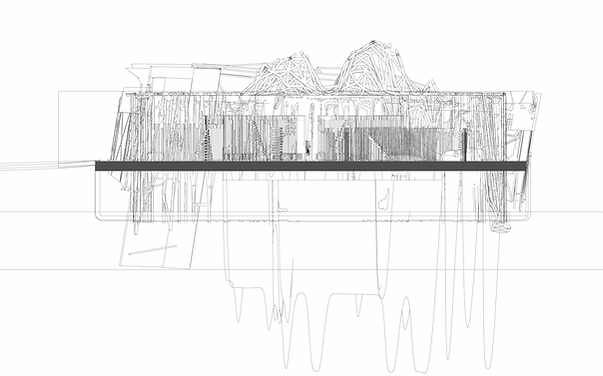

Figure 2.2 & 2.3 Front Elevation Layers
Court section provides insight into the vision behind the lattice top. Its inherently porous network creates filtered visibility while allowing for light to enter the space in abundance. Seen within the section is the fluted walls which divide the space internally, various posts and columns which repeat the language of the facade.

Figure 2.4 Floor Plan/Ariel View
Court plan showing poche of inner mechanics of the network of rooms and hallways, rooms maintaining platforms as noted in introduction, and columns throughout opening rooms up to passer-byers in an experiential way, lasting for the moment their view inward is allowed then dematerialized.


Figure 2.5 & 2.6 Interior Rendering of Court Program and Materials
Housing Corridors
Housing Corridors
The housing component is meant to establish a community of women harmed in the legal process looking to rebuild their lives with assurance and stability.

Figure 3.1 Rendering of Housing Complex
The latticework present in the courthouse is repeated here, along with earthen tones, however with a silver lining. Various access points exist into the residence.

Figure 3.2 Floor Plan
The floor plan explores the diverse units of single users to larger more expansive designs to accommodate multiple people.
Library
Library
the library acts as a berm alongside the two programs, nestling them while formalizing the campus as a unified identity. The library is a long spiraling loop one can ascend as light pours in the glass facade.

Figure 4.1 Rendering of Library
The rendering displays the grand scale and linking character of the library to create a cohesive/unified site.


Figure 4.2 & 4.3 Front Elevation Layers
Library section delineating the mesh of glass and multistories of literature and potential to wander upward, a metaphor the liberation and upward mobility stemming from legal reparations and investment into free and available knowledge and education. Below are the aforementioned tunnels and hollows that enable circulation in an expanded sense.